
When evaluating an ecommerce platform, license fees alone are misleading. The real metric is Total Cost of Ownership (TCO): all costs to build, run, scale, and maintain your store over time.
Independent research shows that Shopify delivers up to 36% lower TCO compared to other major platforms, while launching faster and requiring significantly less operational overhead.
For growing brands, this difference compounds quickly.
What is Total Cost of Ownership in Ecommerce?
Total Cost of Ownership (TCO) includes every cost involved in running your webshop:
Platform & subscription fees. Implementation & migration costs. Hosting & infrastructure. Maintenance, updates & security. Developer & agency dependency. Operational and support costs. Time-to-market and internal workload.
A platform with lower upfront fees but higher complexity often ends up more expensive over 3–5 years.
Shopify vs Other Ecommerce Platforms: TCO Compared
Shopify commissioned an independent consultancy to compare TCO across leading platforms in North America, including Magento, WooCommerce and BigCommerce.
Up to 36% better Total Cost of Ownership: Shopify delivers the highest value at the lowest total cost, once all factors are included.
49% lower implementation & migration costs: Competitors typically require custom infrastructure setup, extensive backend configuration, and heavier frontend customization. Shopify's architecture eliminates much of this complexity.
37% faster time-to-launch: Faster implementation means earlier revenue, lower project risk, and less internal coordination overhead.
23% lower operational & support costs: Shopify includes hosting, security & compliance, updates & performance optimization. No separate DevOps teams required.
30% lower platform & commerce technology costs: This includes platform fees, payment infrastructure, and ongoing support.
Why Shopify's TCO Is Structurally Lower
Shopify isn't cheaper by coincidence. Its architecture is designed to remove hidden costs.
SaaS by design: No servers to manage, no upgrades to plan, no security patches to deploy.
App-first ecosystem: Most functionality is available via mature, well-maintained apps instead of custom builds.
Reduced developer dependency: Internal teams can handle more themselves, lowering long-term agency and development spend.
Scales without replatforming: From €1M to €100M+ revenue, Shopify scales without needing a rebuild.
The Hidden Cost Most Brands Miss: Complexity
Platforms that promise "full flexibility" often deliver higher technical debt, slower innovation, and harder onboarding of new team members.
Complexity is not free. Shopify minimizes it by design.
When Shopify Delivers the Highest ROI
Shopify is especially cost-effective for growing DTC and B2B brands, international ecommerce, teams without large in-house engineering departments, and businesses prioritizing speed, stability and scalability.
At Zinzo, we typically see Shopify outperform alternative platforms within 12–18 months purely on TCO.
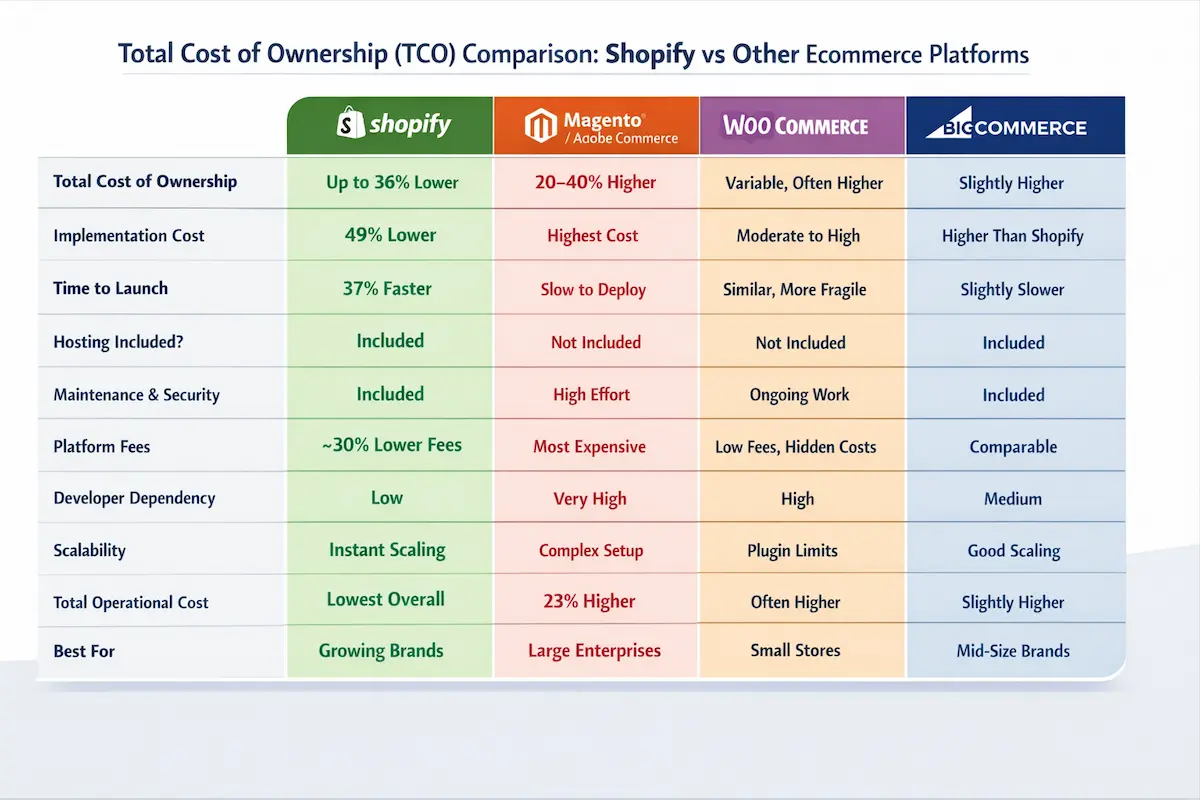
Total Cost of Ownership Comparison: Shopify vs Other Ecommerce Platforms
| Cost Category | Shopify | Magento / Adobe Commerce | WooCommerce | BigCommerce |
|---|---|---|---|---|
| Total Cost of Ownership (3–5 years) | Up to 36% lower | 20–40% higher | Highly variable, often higher | Slightly higher |
| Implementation & Migration Cost | 49% lower | Highest due to complexity | Moderate to high (plugins & setup) | Higher than Shopify |
| Time to Launch | 37% faster | Slow (complex setup) | Comparable, but more fragile | Slightly slower |
| Hosting & Infrastructure | Included | Not included | Not included | Included |
| Maintenance & Security | Included | High ongoing effort | Continuous plugin/security work | Included |
| Platform Fees | ~30% lower overall | Highest licensing fees | Low base fee, hidden costs | Comparable |
| Developer Dependency | Low | Very high | High | Medium |
| Scalability | Instant scaling | Requires DevOps & infra scaling | Plugin performance limits | Good scaling |
| Total Operational Costs | Lowest | ~23% higher | Often higher long-term | Slightly higher |
| Best Fit For | Growing D2C & B2B brands | Large enterprise organizations | Small shops with limited budgets | Mid-sized ecommerce brands |
Frequently Asked Questions
What costs are included in ecommerce TCO?
TCO includes platform fees, implementation, hosting, maintenance, security, developer costs, operational overhead, and time-to-market delays.
How much can Shopify save compared to Magento or WooCommerce?
Independent research shows up to 36% lower total cost of ownership, with 49% lower implementation costs and 23% lower operational expenses.
Is Shopify suitable for enterprise-level businesses?
Yes. Shopify Plus scales from €1M to €100M+ revenue without requiring a platform rebuild, making it ideal for growing enterprises.
Why is Shopify's implementation faster?
Shopify's SaaS architecture eliminates custom infrastructure setup, extensive backend configuration, and heavy frontend customization that competitors require.
Conclusion
Choosing an ecommerce platform is not about features — it's about long-term cost, speed and optionality.
Independent research confirms: lower total cost, faster implementation, lower operational overhead. That's why Shopify consistently wins on Total Cost of Ownership.
Want to explore how Shopify compares for your business case? Talk to a Shopify Engineer at Zinzo.